Our Technologies

Screw Vacuum pumps & compressors

How Screw Vacuum Pumps & Compressors Work: Technology, Components, and Industrial Applications

Screw vacuum pumps and compressors are among the most reliable and energy-efficient technologies for handling air and gas in industrial processes. Known for their oil-free or oil-lubricated operation, continuous duty capability, and high volumetric efficiency, screw pumps are widely used across manufacturing, processing, and energy sectors. This article explains how screw vacuum pumps and compressors work, the details of their essential components, the physics behind vacuum and compression, their effective vacuum range, and examples of industrial applications.

Screw vacuum pumps and compressors operate using a positive displacement principle. Inside the pump housing, two parallel, counter-rotating screw rotors (male and female) trap incoming air or gas. As the screws rotate, the gas is progressively sealed within the spaces between the rotor lobes and the casing. This trapped gas is then transported along the screw shafts towards the discharge end.

In vacuum operation, gas molecules are continuously drawn from a chamber, creating a pressure lower than atmospheric.

In compression operation, the trapped gas volume is gradually reduced, increasing its pressure before discharge.

The process is continuous, pulsation-free, and highly efficient, making screw pumps ideal for stable vacuum and compression duties.

  • Twin Screw Rotors – The core elements of the pump, precisely machined to intermesh without contact, ensuring gas compression and transfer.
  • Pump Housing – A robust chamber that encloses the screws and provides the gas flow path while maintaining clearance tolerances.
  • Timing Gears (in dry screw models) – Ensure the rotors remain synchronized without physical contact, preventing wear and extending service life.
  • Bearings and Seals – Support the rotors, maintain alignment, and ensure gas containment with minimal leakage.
  • Cooling System – May be air-cooled or water-cooled, regulating temperatures generated during compression.
  • Lubrication System (in oil-injected models) – Provides rotor sealing, heat dissipation, and friction reduction for smooth operation.
  • Inlet and Discharge Ports – Manage the gas entry and exit, optimized to minimize pressure losses and maximize efficiency.

The physics of screw technology is based on gas displacement and volume reduction. When air or gas enters the inlet:

  • Vacuum Mode: The screws continuously expand the chamber volume at the inlet, reducing pressure and allowing external gas to flow in. As the screws rotate, the gas is sealed and transported, creating a suction effect.
  • Compression Mode: The screws progressively reduce the trapped volume of gas, increasing its pressure according to Boyle’s Law (P1V1 = P2V2). The compressed gas is then discharged at the outlet.

Because the screws rotate smoothly, the process eliminates pulsations, ensuring a steady vacuum or pressure flow.

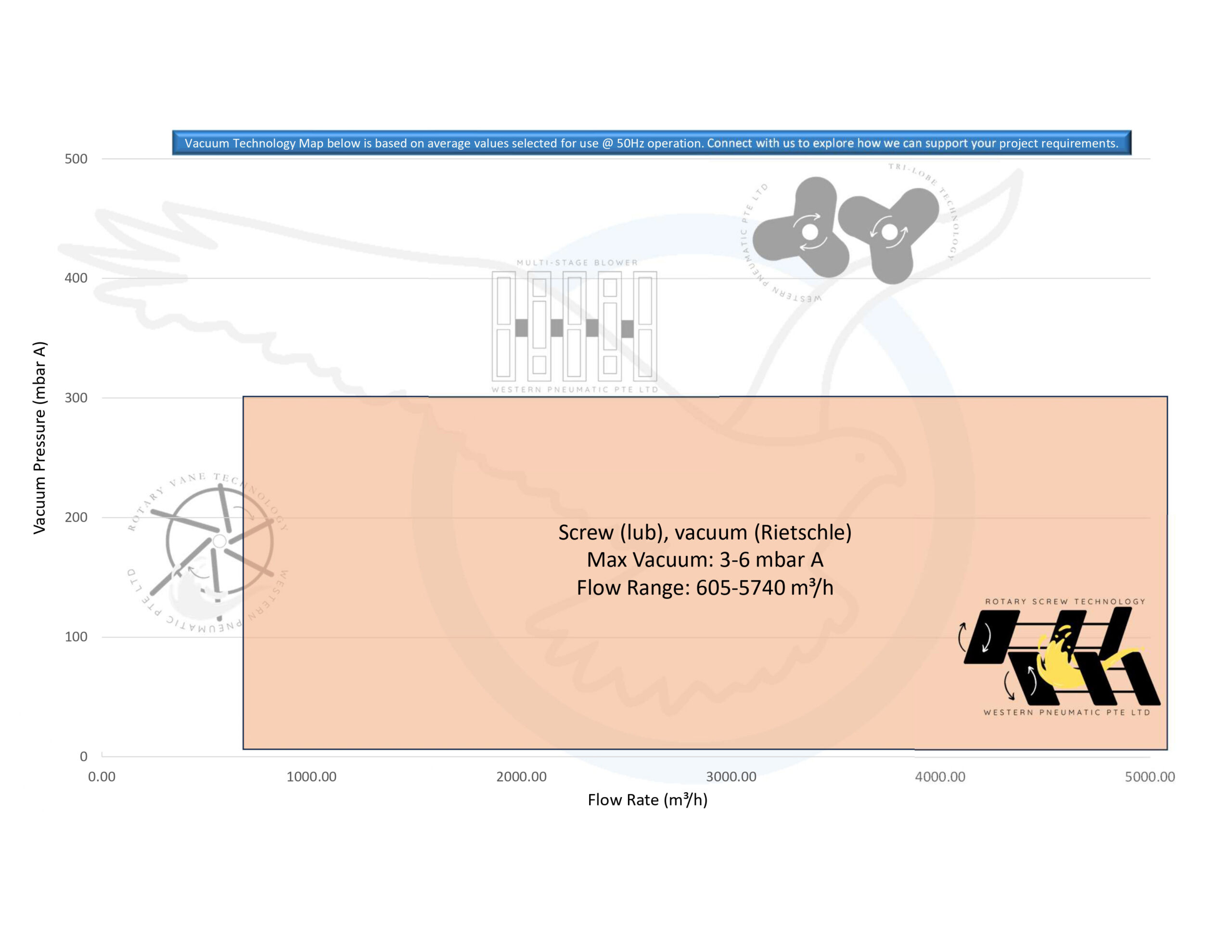
Screw vacuum pumps are designed to operate efficiently across medium to low vacuum ranges.

  • Ultimate Vacuum: Typically down to 0.01 mbar (absolute) for dry screw pumps.
  • Compression Range: Compressors can achieve discharge pressures of up to 10 bar(g) or higher depending on the configuration.

Screw vacuum pumps and compressors are used in industries where clean, oil-free, and reliable performance is critical. Examples include:

  • Chemical & Pharmaceutical Processing – Vacuum distillation, solvent recovery, drying, crystallization.
  • Food & Beverage Industry – Vacuum packaging, freeze-drying, fermentation aeration.
  • Semiconductor & Electronics – Clean vacuum environments for coating, etching, and wafer handling.
  • Plastics & Rubber Processing – Degassing, extrusion, and molding.
  • Energy & Environmental – Biogas compression, vapor recovery, wastewater aeration.
  • General Industry – Pneumatic conveying, central vacuum systems, and compressed air supply.