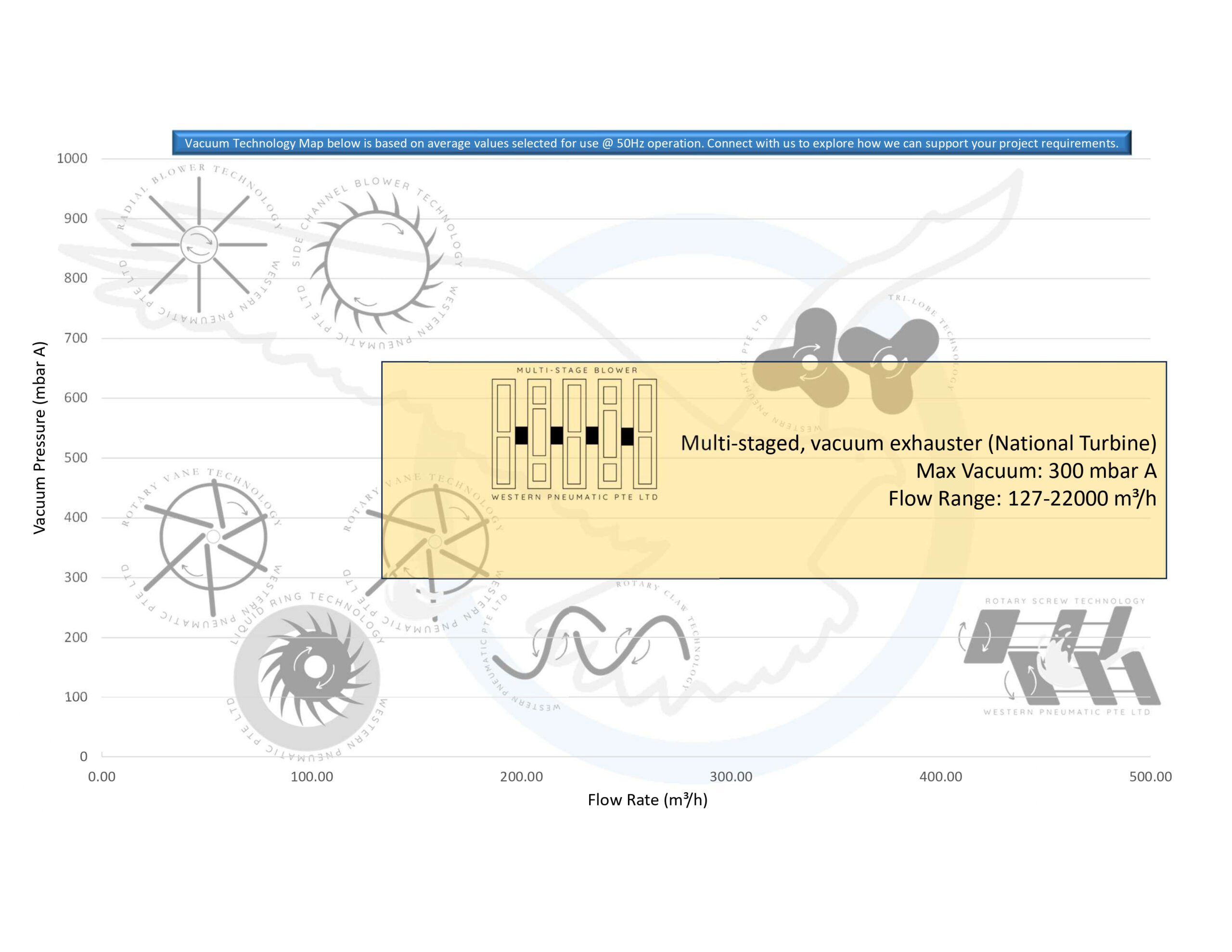
At the heart of a multi-stage blower lies the principle of dynamic compression, where air or gas is accelerated by a high-speed rotating impeller and then diffused to convert velocity energy into pressure.
- Air Inlet: Ambient air enters the blower housing and is directed toward the first impeller.
- Impeller Acceleration: Each impeller, rotating at high speed, imparts kinetic energy to the incoming air.
- Diffusion Stage: After passing through the impeller, the air slows down in a diffuser, converting velocity energy into static pressure.
- Staged Compression: The air is redirected into the next impeller, where the process repeats, gradually building pressure across multiple stages.
- Outlet Discharge: Finally, the compressed air exits through a volute or collector designed to minimize energy losses and vibration.
For centrifugal exhausters operating under vacuum mode, the principle is reversed: air is drawn into the inlet at low pressure, accelerated by impellers, and discharged at atmospheric conditions, thereby creating a vacuum on the suction side.