Our Technologies

Liquid Ring Pump

How Liquid Ring Vacuum Pumps Work: Principles, Components, and Industrial Applications

Liquid Ring Vacuum Pumps are one of the most versatile and widely used vacuum technologies in modern industries. Known for their robustness, reliability, and ability to handle wet, saturated, and dirty gas streams, these pumps are a top choice for processes that demand stable vacuum generation under harsh operating conditions. This article explains in detail how a liquid ring vacuum pump works, the role of each essential component, the physics behind vacuum generation, its effective operating range, and real-world applications across industries.

The operation of a liquid ring vacuum pump is based on the centrifugal force principle and the interaction between a rotating impeller and a liquid seal (typically water or another compatible liquid).

  • Impeller Rotation:
    The pump consists of a multi-bladed impeller mounted eccentrically inside a cylindrical casing. As the impeller rotates, the blades trap pockets of gas.
  • Liquid Seal Formation:
    A sealing liquid (commonly water, oil, or a process-compatible fluid) is introduced into the casing. Under centrifugal force, this liquid forms a rotating “liquid ring” against the casing walls.
  • Variable Compression Chambers:
    Because the impeller is off-center, the liquid ring is closer to the impeller hub on one side and farther on the other. This creates variable volume chambers between the impeller blades.
  • Suction Phase:
    As the volume between the impeller blades increases, gas is drawn into the chamber through the suction port.
  • Compression and Discharge:
    As the impeller rotates further, the trapped gas is compressed by the liquid ring as the chamber volume decreases. This compressed gas is then expelled through the discharge port.

This continuous cycle of suction, compression, and discharge enables the pump to generate vacuum or compress gas depending on system configuration.

  • Pump Casing
    • Cylindrical housing that holds the liquid ring and impeller.
    • Designed with suction and discharge ports to control gas flow.
  • Impeller
    • Radial blades mounted eccentrically inside the casing.
    • Drives gas compression by creating variable chamber volumes.
  • Liquid Seal (Operating Fluid)
    • Forms the liquid ring essential for compression.
    • Often water, but process-specific liquids may be used for chemical compatibility or vapor handling.
  • Shaft and Bearings
    • Transmit torque from the motor to the impeller.
    • High-grade bearings reduce vibration and enhance operational stability.
  • Port Plates
    • Direct gas flow between suction and discharge phases.
    • Precisely engineered for efficiency and minimized leakage.
  • Mechanical Seals or Packing
    • Prevent leakage of process gases and sealing liquid.
    • Ensures reliability under varying pressure conditions.
  • The Physics Behind Vacuum Generation
    • The vacuum is produced due to positive displacement and centrifugal dynamics:
  • Gas Expansion and Compression: As the impeller rotates eccentrically, gas volumes expand (suction) and contract (compression). This pressure difference draws gas into the pump and pushes it out against atmospheric or discharge pressure.
  • Liquid Ring as a Piston: Instead of a solid piston, the liquid ring acts as a flexible piston that adapts to changing gas flow, allowing smooth handling of vapors, condensable gases, and even liquid slugs.
  • Heat Absorption by Liquid Seal: The sealing liquid absorbs compression heat, making liquid ring pumps capable of handling saturated gases without overheating.
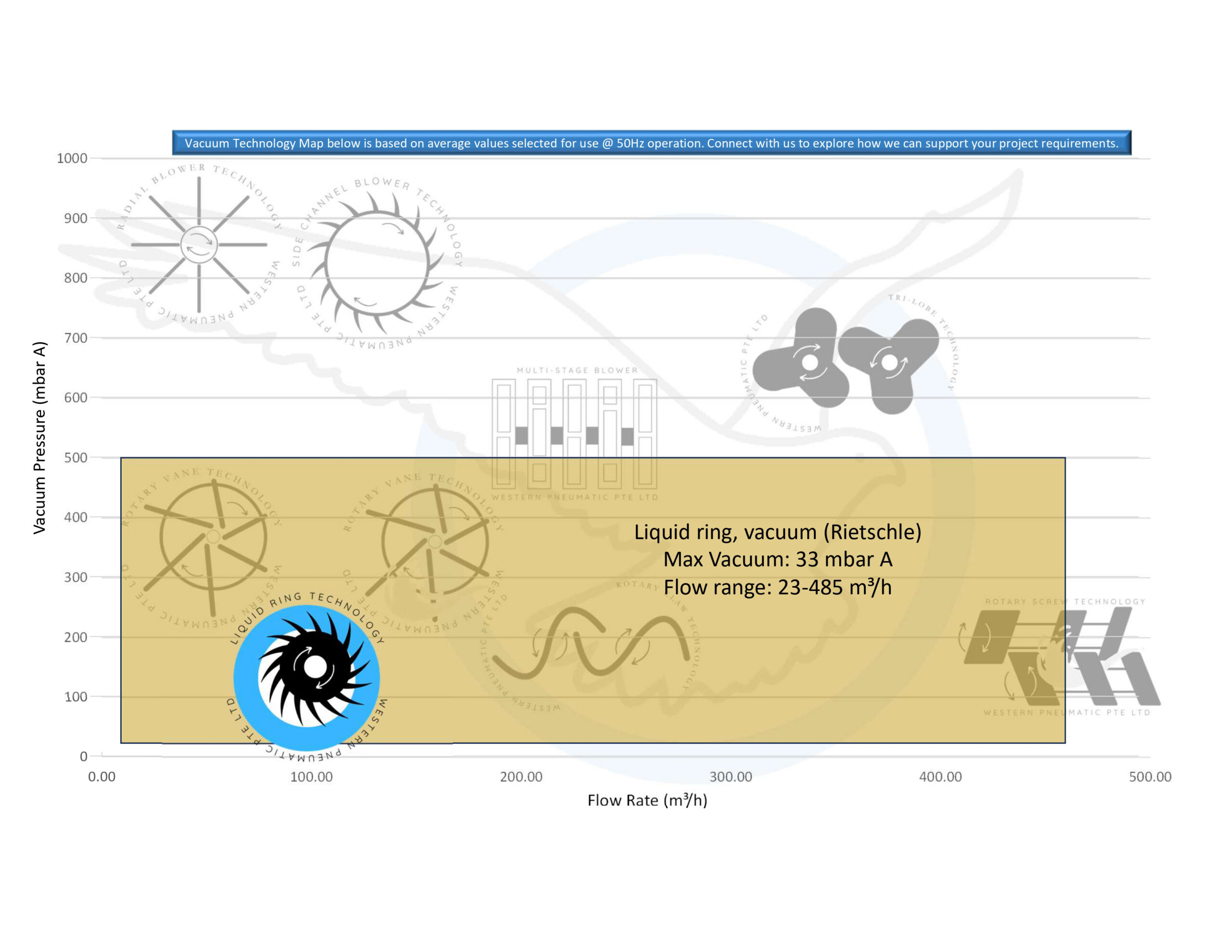
  • Typical Vacuum Range: 33 mbar(a) to 1,013 mbar(a) (absolute pressure).
  • Two-Stage Liquid Ring Pumps: Can reach deeper vacuum levels of up to 25 mbar(a).
  • Compression Applications: When configured for gas compression, discharge pressures can reach up to 2 bar(g) or higher.
  • This makes them suitable for both vacuum generation and low-pressure gas compression.
  • Industrial Applications of Liquid Ring Vacuum Pumps
  • Due to their ability to handle wet, corrosive, or particulate-laden gases, liquid ring vacuum pumps are widely used in industries such as:
  • Chemical and Pharmaceutical Industry
    • Solvent recovery
    • Vacuum distillation
    • Drying and filtration processes
  • Power Generation
    • Condenser exhausting in steam turbine systems
    • Air removal in condenser systems
  • Paper and Pulp Industry
    • Paper dewatering
    • Vacuum couch rolls
    • White water extraction
  • Mining and Metallurgy
    • Flotation processes
    • Gas extraction from shafts
  • Food and Beverage Processing
    • Vacuum packaging
    • Concentration and evaporation of juices or dairy products
  • Oil and Gas Industry
    • Vapor recovery units
    • Gas compression and flare gas recovery