Our Technologies

Two lobe and Tri-Lobe Blower

Two-Lobe and Tri-Lobe Blowers: Working Principle, Differences, and Industrial Applications

In industrial air movement and vacuum generation, rotary lobe blowers play a vital role in ensuring reliable, oil-free, and consistent airflow. Among the most common designs are the two-lobe blower (Roots blower) and the tri-lobe blower. Both technologies are positive displacement machines, designed to deliver large volumes of air at low pressures or create vacuum at low absolute pressures. While their fundamental operating principle is similar, subtle differences in rotor geometry, efficiency, and performance characteristics distinguish the two.

Principle of Operation

Both two-lobe and tri-lobe blowers operate on the positive displacement principle. The device consists of two rotors mounted on parallel shafts within a precisely machined housing. These lobes rotate in opposite directions without contacting each other or the casing, thanks to a synchronizing timing gear system.

  • As the lobes rotate, they trap a fixed volume of air in the cavities between the rotor lobes and the casing.
  • The trapped air is carried from the inlet side to the discharge side of the blower.
  • Since the lobes do not compress air internally, compression occurs externally when the discharged air is forced against system resistance, creating either low-pressure airflow or low vacuum.

This external compression process results in pulsating flow in two-lobe blowers, whereas tri-lobe designs mitigate pulsation by offering smaller displacement volumes per rotation.

  • Rotors (Lobes): The heart of the blower.
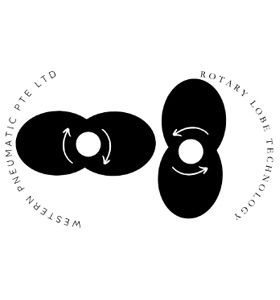
    • Two-lobe rotors: Two large lobes with 180° symmetry.
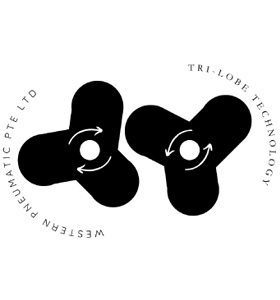
    • Tri-lobe rotors: Three lobes spaced at 120° intervals, providing smoother discharge.
  • Casing/Housing:
    Precisely machined chamber where air is trapped and transferred.
  • Timing Gears:
    Synchronize the rotation of both lobes, preventing contact and wear.
  • Bearings and Shafts:
    Support and ensure smooth rotor movement under high load conditions.
  • Seals:
    Prevent leakage between high- and low-pressure sides, maintaining system efficiency.
  • Inlet & Outlet Ports:
    Control the air entry and exit paths, designed for optimized flow and minimal turbulence.

The blower itself does not compress air internally. Instead, it delivers displaced air volume into a system where:

  • For pressure generation: The blower pushes atmospheric air into a closed system, building pressure as resistance increases.
  • For vacuum generation: The blower draws air out of a system, reducing pressure inside compared to the surrounding atmosphere.
  • This is governed by the ideal gas law (PV=nRT), where reducing system volume or removing air molecules lowers system pressure.
  • Two-lobe blowers have a more abrupt compression cycle, leading to pressure pulsations.
  • Tri-lobe blowers distribute displacement more evenly per revolution, reducing vibrations and pulsation effects.
  • Two-lobe blowers:
    • Pressure: up to 1 bar(g) (14.7 psig).
    • Vacuum: down to -500 mbar(g) (~500 mbar absolute).
  • Tri-lobe blowers:
    • Pressure: up to 1.2 bar(g) (17 psig).
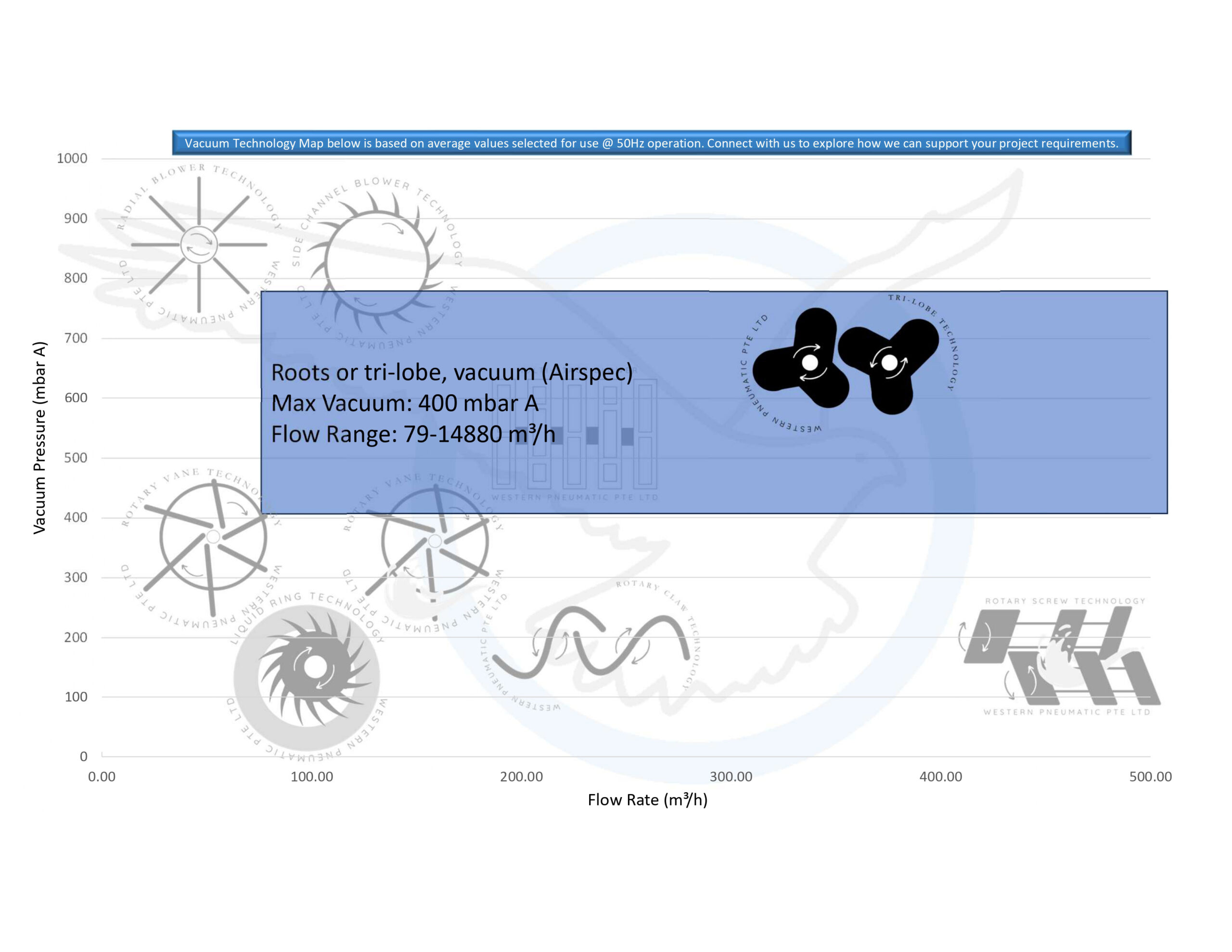
    • Vacuum: down to -500 to -700 mbar(g) (~300 mbar absolute with boosting stages).
FeatureTwo-Lobe BlowerTri-Lobe Blower
Rotor GeometryTwo lobes (180°)Three lobes (120°)
Pulsation & NoiseHigher pulsation, noisierReduced pulsation, quieter
EfficiencyModerateHigher due to smoother flow
VibrationHigher vibrationLower vibration
Operating SpeedLower speed rangeCan operate at higher speeds
CostGenerally lowerSlightly higher due to complexity
ApplicationsTraditional industries, where cost is criticalModern industries, where efficiency and noise control are important

Two-Lobe Blowers

  • Advantages:
  • Simpler design, easy maintenance
  • Lower initial cost
  • Proven reliability in long-term use
  • Disadvantages:
  • Higher pulsation leading to noise and vibration
  • Less energy-efficient
  • Limited to lower pressure/vacuum ranges

Tri-Lobe Blowers

  • Advantages:
  • Smoother air delivery with reduced pulsations
  • Lower noise and vibration levels
  • Higher energy efficiency
  • Can operate at higher speeds, handling greater capacities
  • Disadvantages:
  • More expensive initial investment
  • Slightly more complex design, requiring skilled servicing

Both two-lobe and tri-lobe blowers find applications in industries where oil-free air movement and low-pressure conveying are required. Common applications include:

  • Wastewater Treatment: Supplying aeration air for biological treatment.
  • Pneumatic Conveying: Transport of powders, grains, and bulk solids in food, cement, and chemical plants.
  • Vacuum Packaging: Creating vacuum environments in food and pharmaceutical packaging.
  • Combustion Air Supply: Providing pressurized air to furnaces and kilns.
  • Textile and Paper Industry: Assisting in drying, fiber handling, and sheet conveying.
  • Aquaculture: Delivering oxygen-rich air to ponds and tanks.