Our Technologies

Radial blowers

How Radial Blowers Work: Components, Physics, Vacuum Range, and Industrial Applications

Radial blowers, also known as centrifugal blowers, are a fundamental technology in industrial air movement systems. They are designed to generate a steady stream of airflow at medium to high pressures, making them indispensable for processes that require either vacuum generation or compressed air delivery. By converting mechanical energy into fluid motion, radial blowers provide reliable, efficient, and controllable air handling in a wide range of industries.

The core function of a radial blower is based on centrifugal force. As the impeller rotates at high speed inside the blower housing, air is drawn into the center (inlet) and accelerated outward through the impeller blades. This action converts kinetic energy into pressure energy, creating a consistent flow of air that exits at a higher pressure or reduced pressure, depending on whether the blower is used for compression or vacuum.

The physics behind this operation can be explained as follows:

  • Air Intake: Air enters axially at the impeller’s eye (center).
  • Acceleration by Impeller: Rotating blades impart velocity to the air, increasing its kinetic energy.
  • Radial Discharge: Due to centrifugal force, the air is flung radially outward into the volute casing.
  • Energy Conversion: The volute geometry transforms the velocity energy into static pressure.
  • Outlet Flow: The pressurized air exits through the discharge port, ready for industrial use.
  • This mechanism allows radial blowers to deliver high pressure at relatively low flow rates compared to axial fans, making them more suited to targeted and demanding applications.
  • Vacuum Generation:
    When operated with an inlet restriction, the blower reduces pressure at the inlet side, creating a vacuum effect. This allows the blower to extract air or gases from a process, transporting or holding materials by suction.
  • Compression and Pressure Build-Up:
    When operated with a free inlet but restricted outlet, the blower generates positive pressure. The air compressed inside the volute casing achieves discharge pressures that are suitable for pneumatic conveying, combustion air supply, or cooling processes.
  • The efficiency of a radial blower depends heavily on impeller design, rotational speed, and system resistance. Backward-curved impellers typically offer higher efficiency, while forward-curved impellers allow greater flow rates at lower noise levels.

A radial blower consists of several precision-engineered parts that work in harmony to produce reliable airflow:

  • Impeller
    • The heart of the blower, typically made from aluminum, steel, or composite materials.
    • Shaped with forward-curved, backward-curved, or radial blades to achieve specific performance.
    • Determines airflow volume, efficiency, and pressure characteristics.
  • Housing (Volute Casing)
    • Spiral-shaped casing that guides the accelerated air toward the outlet.
    • Converts kinetic energy into static pressure efficiently.
    • Designed to minimize turbulence and noise.
  • Inlet Nozzle
    • Smoothly channels incoming air into the impeller eye.
    • Reduces entry losses and ensures optimal airflow distribution.
  • Drive System
    • Can be directly coupled (motor shaft connected to impeller) or belt-driven.
    • Provides the mechanical energy needed for rotation.
  • Bearings and Shaft
    • Support smooth, stable impeller rotation at high speeds.
    • Precision bearings reduce friction, extend blower life, and minimize vibration.
  • Sealing System
      • Prevents air leakage and contamination from dust or oil.
      • Critical for applications in clean industries such as food, pharmaceuticals, and electronics.

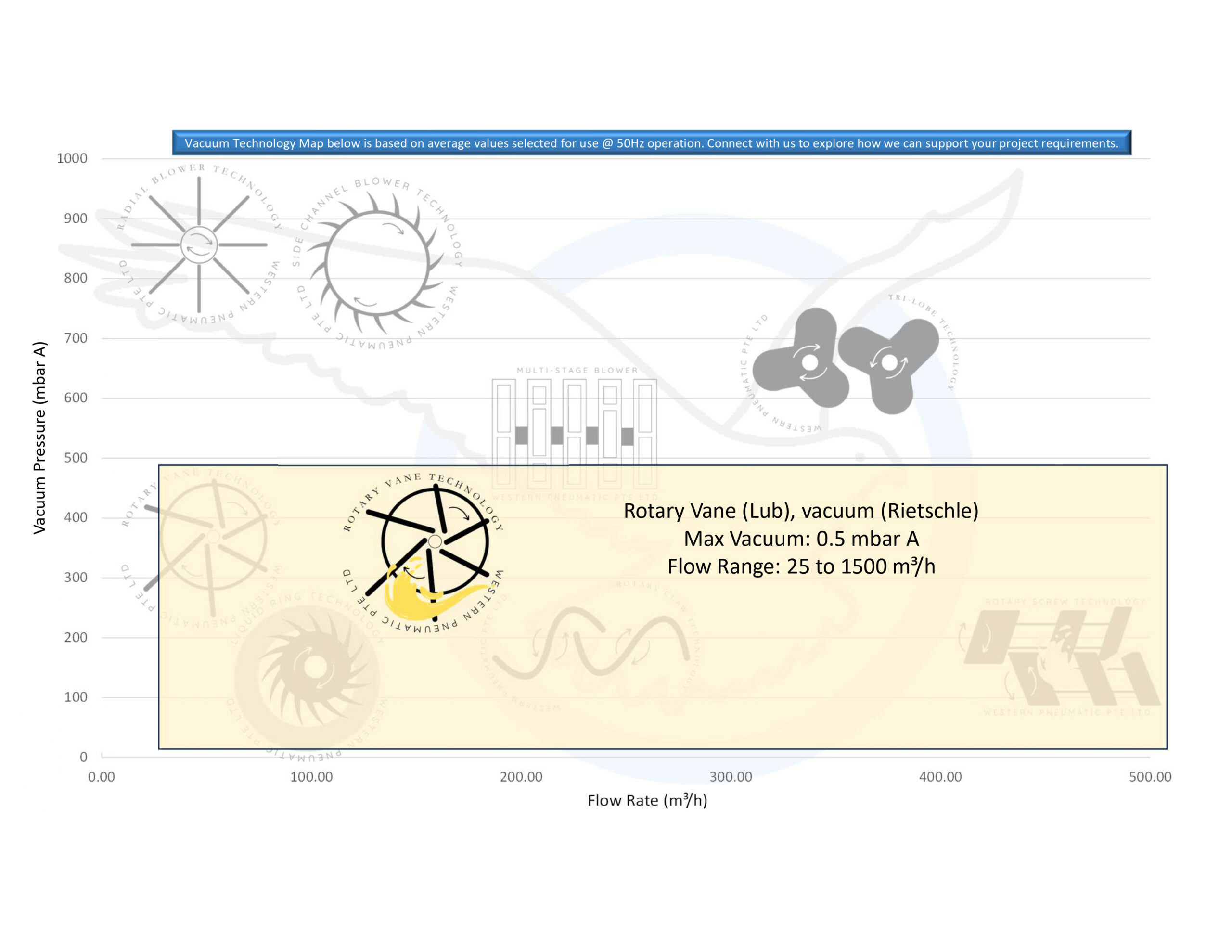
Radial blowers operate in the medium pressure and medium vacuum range compared to side-channel or rotary vane technologies. Typical performance values include:

  • Vacuum range: up to -200 to -400 mbar (depending on design and speed).
  • Pressure range: up to +400 to +1000 mbar.
  • Flow rate: from 50 m³/h for compact units to over 10,000 m³/h for large industrial blowers.

This makes radial blowers an ideal choice for processes that do not require deep vacuum (such as rotary vane pumps) or extremely high pressures (such as compressors), but rather a balance of moderate vacuum, reliable pressure, and high airflow volume.


Radial blowers are highly versatile and serve a wide spectrum of industries. Some key applications include:

  • Pneumatic Conveying: Transporting bulk powders, granules, and pellets in food, chemical, and plastics industries.
  • Vacuum Cleaning Systems: Centralized vacuum plants in industrial facilities and large commercial spaces.
  • Combustion Air Supply: Providing controlled air streams to burners, boilers, and furnaces.
  • Cooling and Drying: Delivering forced air to cool machinery, electronic components, or dry materials.
  • Environmental Engineering: Aeration in wastewater treatment, dust collection, and fume extraction.
  • Medical and Laboratory Equipment: Supplying clean air for vacuum tables, filtration systems, and sterilization units.
  • Textile and Printing: Assisting in material handling, suction tables, and process air support.

Brands: