Our Technologies

Rotary Vane Vacuum Pumps & Compressors

Rotary Vane Vacuum Pumps & Compressors: Working Principle, Components, Physics, and Industrial Applications

Rotary vane vacuum pumps and compressors are among the most widely used technologies in modern industry for generating vacuum or compressed air. Known for their reliability, compact design, and cost-effectiveness, these machines operate on a simple yet highly efficient principle. This page explains how rotary vane technology works, the role of its essential components, the physics behind vacuum and compression, effective operating ranges, and examples of industrial applications.

At the core of rotary vane technology lies a rotor mounted eccentrically inside a cylindrical housing (also called the stator). The rotor is fitted with sliding vanes that move in and out of slots, forming sealed chambers.

As the rotor spins:

  • Intake Phase – Air or gas enters the pump through the inlet port into the expanding chamber created by the moving vanes.
  • Compression/Exhaust Phase – As the rotor continues turning, the chamber volume decreases. The trapped gas is compressed and expelled through the exhaust port in compressors, or removed from the chamber in vacuum pumps.

This continuous rotary motion ensures a smooth, pulsation-free flow of air or vacuum.

A rotary vane vacuum pump or compressor consists of several key components, each with a critical function:

  • Rotor – Mounted off-center, it drives the vanes and creates variable chamber sizes necessary for suction and compression.
  • Vanes – Sliding blades, usually made of graphite or carbon composite, that move in and out of the rotor slots to maintain tight sealing and chamber formation.
  • Stator (Housing) – The cylindrical casing in which the rotor turns. Its offset position relative to the rotor ensures chamber size changes during operation.
  • Inlet Port – The entry point for gas or air into the pump or compressor.
  • Exhaust Port – The outlet through which compressed air exits (in compressors) or evacuated gas is discharged (in vacuum pumps).
  • Lubrication System (in oil-lubricated models) – Provides sealing, cooling, and lubrication of moving parts.
  • Bearings and Seals – Ensure smooth rotor motion and prevent leakage between chambers.

The working principle of rotary vane pumps is based on positive displacement and gas laws:

  • Positive Displacement – The rotating vanes trap a fixed volume of gas in a chamber, then reduce its size to increase pressure or increase its size to create a vacuum.
  • Boyle’s Law – At a constant temperature, the pressure of a gas is inversely proportional to its volume. As the chamber volume decreases, gas pressure rises (compression). Conversely, as chamber volume increases, pressure drops (vacuum creation).
  • Vacuum Creation – By continuously expanding and compressing chambers, the pump lowers the pressure inside the system compared to atmospheric pressure, generating a vacuum.
  • Compression Process – In compressor mode, the chamber pressure rises above atmospheric pressure before being expelled as compressed air.

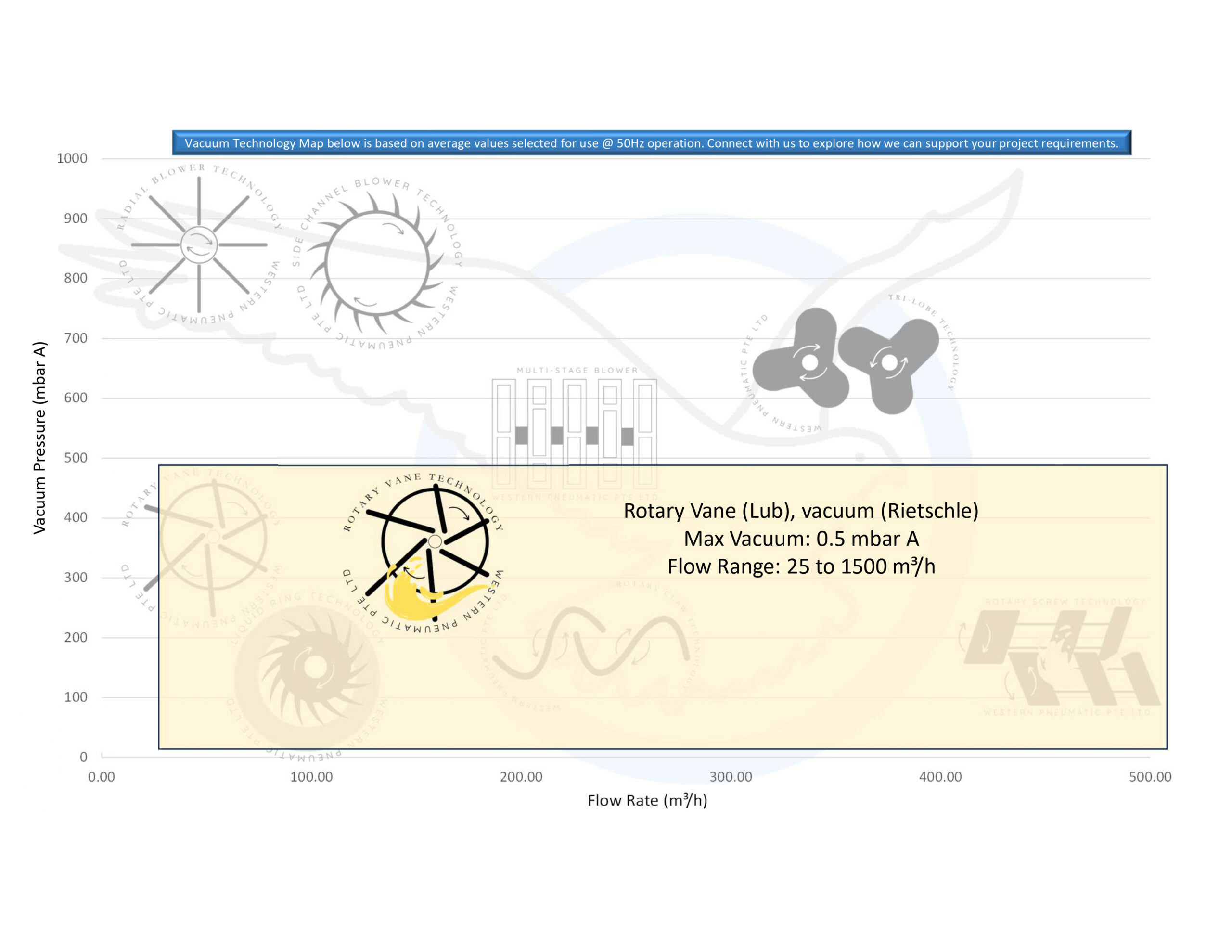
Rotary vane vacuum pumps typically achieve an ultimate vacuum level between 0.1 and 1 mbar (absolute pressure) in lubricated versions, making them ideal for medium to high-vacuum applications. Oil-free variants generally reach around 100–200 mbar, suitable for processes that cannot tolerate oil contamination.

On the compressor side, rotary vane compressors can generate pressures up to 2 bar (gauge), depending on design and application.

Rotary vane vacuum pumps and compressors are versatile, making them widely adopted across industries:

  • Packaging Industry – Used in vacuum packaging of food products, extending shelf life and maintaining freshness.
  • Medical & Healthcare – Deployed in vacuum suction, dental systems, and sterilization chambers.
  • Printing & Paper – Assist in sheet separation, drying, and ink transfer processes.
  • Plastics & Composites – Essential for vacuum forming, degassing, and resin infusion.
  • Automotive – Used in brake boosting systems, leak detection, and component testing.
  • General Manufacturing – Provide compressed air or vacuum for handling systems, pneumatic conveying, and automation.