A radial blower consists of several precision-engineered parts that work in harmony to produce reliable airflow:
- Impeller
- The heart of the blower, typically made from aluminum, steel, or composite materials.
- Shaped with forward-curved, backward-curved, or radial blades to achieve specific performance.
- Determines airflow volume, efficiency, and pressure characteristics.
- Housing (Volute Casing)
- Spiral-shaped casing that guides the accelerated air toward the outlet.
- Converts kinetic energy into static pressure efficiently.
- Designed to minimize turbulence and noise.
- Inlet Nozzle
- Smoothly channels incoming air into the impeller eye.
- Reduces entry losses and ensures optimal airflow distribution.
- Drive System
- Can be directly coupled (motor shaft connected to impeller) or belt-driven.
- Provides the mechanical energy needed for rotation.
- Bearings and Shaft
- Support smooth, stable impeller rotation at high speeds.
- Precision bearings reduce friction, extend blower life, and minimize vibration.
- Sealing System
- Prevents air leakage and contamination from dust or oil.
- Critical for applications in clean industries such as food, pharmaceuticals, and electronics.
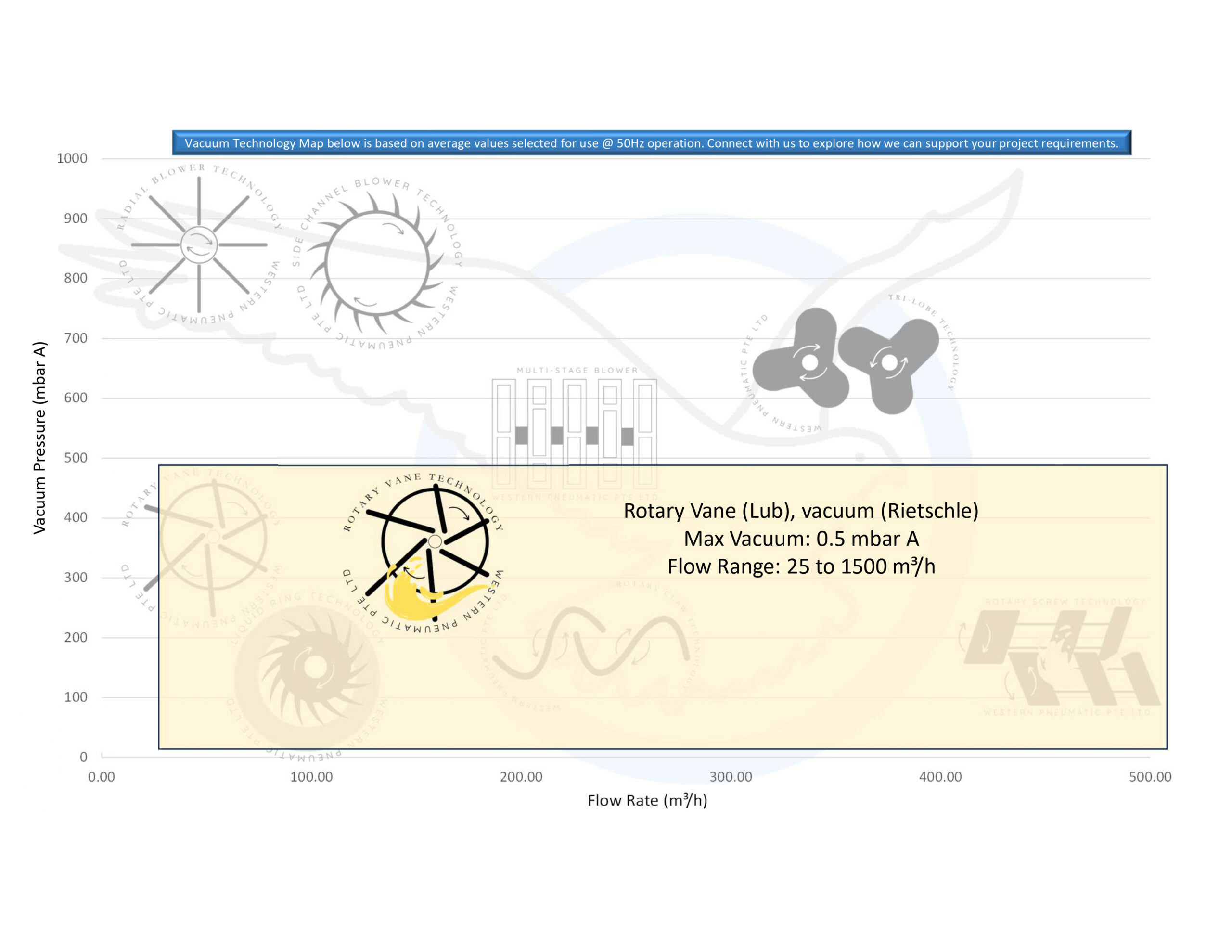
Radial blowers operate in the medium pressure and medium vacuum range compared to side-channel or rotary vane technologies. Typical performance values include:
- Vacuum range: up to -200 to -400 mbar (depending on design and speed).
- Pressure range: up to +400 to +1000 mbar.
- Flow rate: from 50 m³/h for compact units to over 10,000 m³/h for large industrial blowers.
This makes radial blowers an ideal choice for processes that do not require deep vacuum (such as rotary vane pumps) or extremely high pressures (such as compressors), but rather a balance of moderate vacuum, reliable pressure, and high airflow volume.