Our Technologies

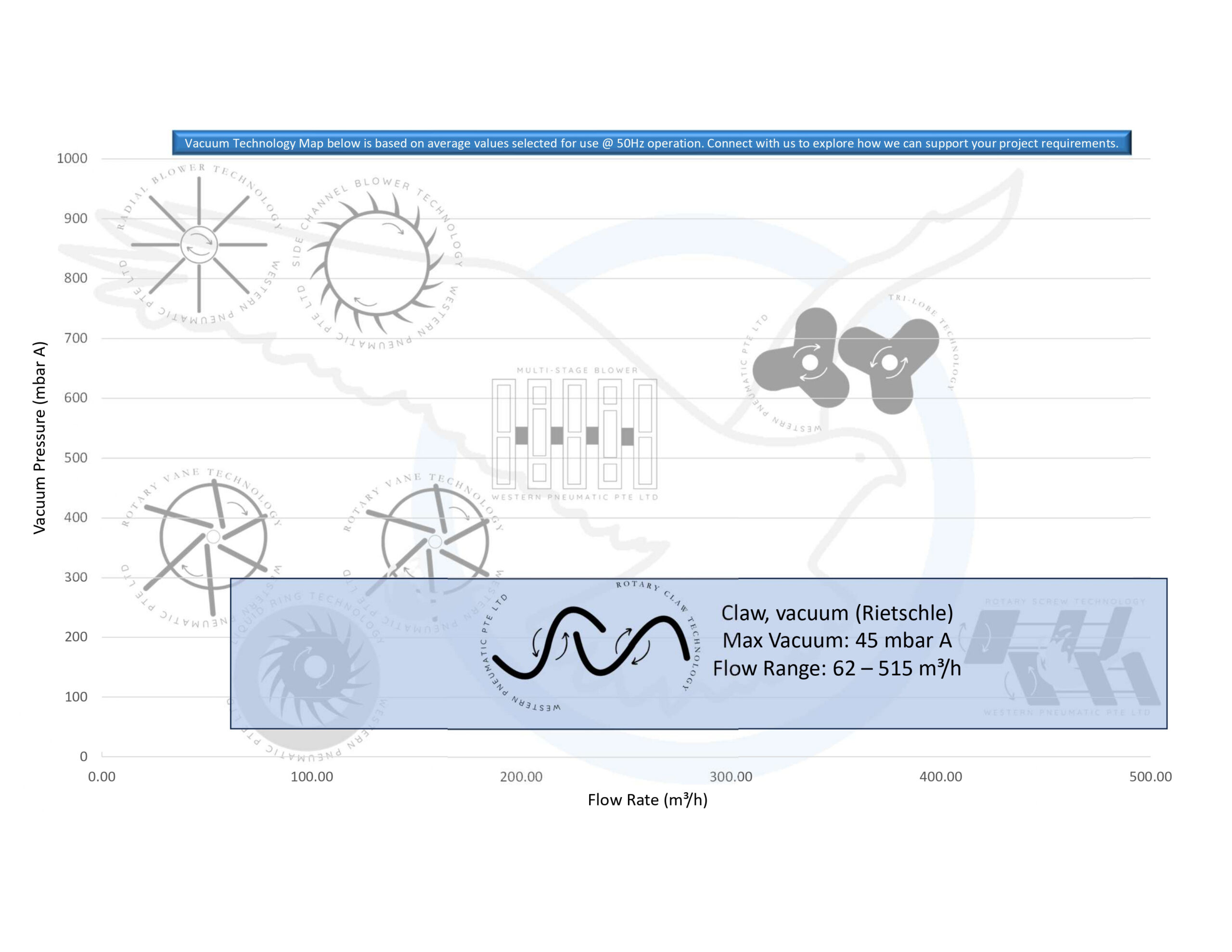
Claw Vacuum pumps & compressors

How Claw Vacuum Pumps & Compressors Work: Technology, Components, Physics, and Industrial Applications

Claw vacuum pumps and compressors are advanced pieces of equipment widely used in modern industries for generating vacuum or compressed air efficiently. Their oil-free, contact-free design makes them highly reliable, energy-efficient, and low-maintenance compared to traditional vacuum technologies. Understanding how claw pumps work, the role of their key components, and the physics behind their operation helps businesses appreciate their advantages and applications.

A claw vacuum pump or compressor is a positive displacement machine that uses two non-contacting, claw-shaped rotors rotating in opposite directions inside a housing. Unlike vane or liquid ring pumps, claw pumps operate without lubrication in the compression chamber, ensuring a completely dry process. This makes them ideal for industries where contamination from oil or water cannot be tolerated.

Claw vacuum pumps are engineered with precision, and each component plays a vital role in their operation:

  • Claw Rotors – The heart of the machine. Two intermeshing, claw-shaped rotors rotate synchronously without contact, driven by a timing gear. Their unique geometry traps and transports air from the inlet to the outlet.
  • Compression Chamber – The housing where the claws operate, ensuring airtight sealing of suction, compression, and discharge stages.
  • Inlet Port – Draws in atmospheric air or process gas into the pump chamber.
  • Outlet Port – Discharges compressed air or vacuumed gases into the downstream system.
  • Timing Gears – Keep the rotors perfectly synchronized, preventing mechanical contact and wear.
  • Cooling System – Either air-cooled or water-cooled designs help maintain optimal operating temperature during continuous duty.
  • Bearings and Seals – Isolated from the compression chamber to ensure oil-free operation and extend machine lifespan.

The operation of claw vacuum pumps relies on the principle of positive displacement. The two claw rotors rotate in opposite directions without touching each other or the housing walls. This motion creates expanding volumes at the inlet, drawing gas into the chamber. As the claws rotate, the trapped volume is moved towards the outlet, where the space decreases, compressing the gas.

Vacuum Generation: When used as a vacuum pump, the claws remove air from a closed system, lowering the pressure inside. The effective vacuum range typically reaches up to 100 mbar(a), making them suitable for medium vacuum applications.

Compression Process: When operated as a compressor, the claws pressurize air or gas as it moves through the chamber, delivering discharge pressures up to 2 bar(g) or higher depending on the design.

Because there is no internal friction, no lubricants are needed in the compression chamber, ensuring pure and uncontaminated airflow.

  • Oil-free operation – No risk of contamination in sensitive processes.
  • Low maintenance – Contact-free design reduces wear and extends service life.
  • Energy efficient – Optimized compression reduces power consumption.
  • Continuous duty – Suitable for 24/7 operation in demanding industries.
  • Quiet and clean – Reduced noise and vibration levels compared to traditional pumps.

Claw vacuum technology is used across multiple industries thanks to its reliability and efficiency:

  • Food & Beverage Industry – Vacuum packaging, bottling, and pneumatic conveying of powders or grains.
  • Pharmaceuticals & Medical – Sterile vacuum environments, tablet coating, and air separation processes.
  • Plastics Industry – Degassing, drying, and thermoforming applications.
  • Woodworking & Printing – Vacuum holding systems for CNC routers and printing presses.
  • Electronics & Semiconductors – Clean, oil-free vacuum for delicate manufacturing processes.
  • Chemical & Environmental Applications – Aeration in wastewater treatment plants and conveying of chemical powders.